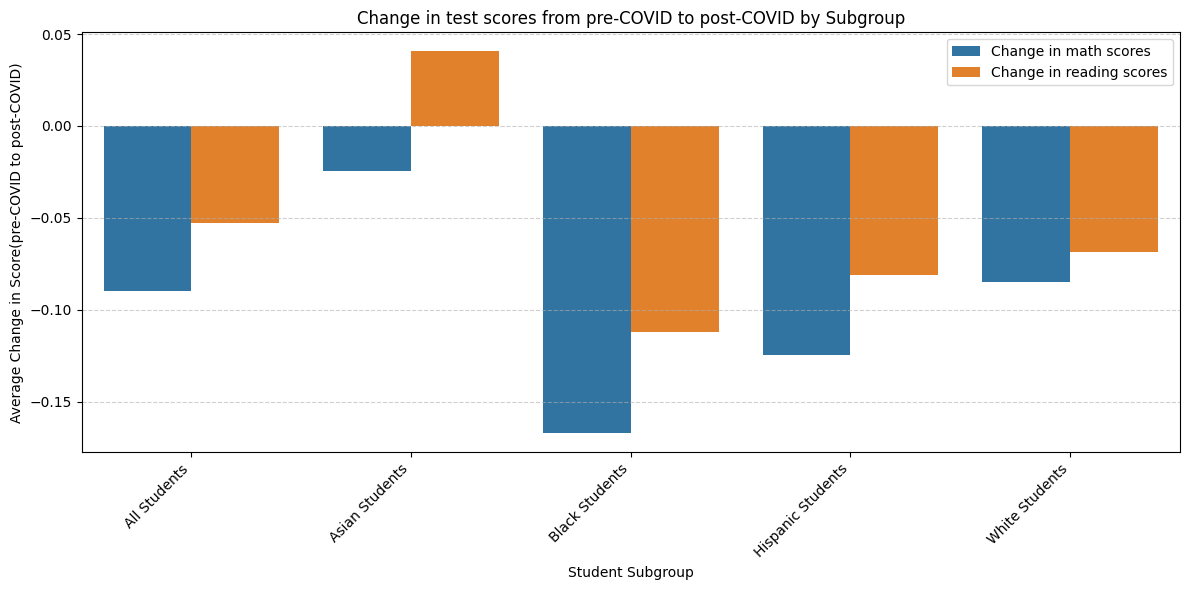
Figure 4. Side-by-side bar graph indicating the change (from pre to post-COVID) of scores for various subgroups
Looking at how different races of students were affected by COVID-19, we see in the data that while all students as a whole suffered a drop in test scores, the drop was most pronounced for Black and Hispanic students. Specifically, Black and Hispanic students’ math scores fell around 0.16 and 0.12 grade levels, respectfully. Our findings agree with existing literature on the subject; Gee et al. explains that school closures in Black and Hispanic neighborhoods, which tend to have fewer resources on average than White and Asian neighborhoods, were more likely to close down during the pandemic, forcing these students online (Gee et al.). Add to this that many of these students didn’t have access to remote learning technology, and it is easy to see how these students fell behind.
Also interestingly, Asian students’ test scores didn’t actually decline at all; instead, they increased during the pandemic, despite the psychological challenges that we believe they may have faced. Gee et al. attributes Asian students’ success during the pandemic relative to other ethnic groups to their outsized use of external learning resources, such as tutoring and supplemental courses (Gee et al.). Chen et al. adds to this by explaining that Asian American culture pushes students to perform well academically by punishing them for underperformance or even average performance (Chen et al.). Furthermore, observing the racism and racial violence faced by Asian Americans during the pandemic, we can see that overall, despite high pressure to succeed and racist experiences, Asian students improved their test scores with the use of external learning resources. If other ethnic groups were to adopt these same practices of external tutoring and learning, we might expect their scores to improve dramatically or resist during more difficult times like the pandemic, but we also recognize that different groups may have disparate access to these resources, making this idealistic prescription quite difficult.