Taken together, our findings reveal an educational terrain shaped not by a single factor but by many interacting forces, including gendered social pressures, racialized access to resources, socioeconomic constraints, and regional policy differences. By diving deeper into individual realities and relationships, we see how each student’s experience during the pandemic was filtered through layered identities, and while a few of our comparisons show that some patterns can be traced to preexisting inequalities, others reflect new pressures introduced by COVID-19. This demonstrates the need to understand people’s identities as interconnected, and that it is at the point of intersection that we can truly understand how the pandemic affected young learners.
Ultimately, our project emphasizes that meaningful educational analysis must move beyond broad averages to consider the varied landscape of lived experiences. Only by respecting and seeking to understand these nuances can we imagine interventions that respond not to a monolithic student body, but to the complex, multifaceted realities that shape learning outcomes in times of crisis and beyond.
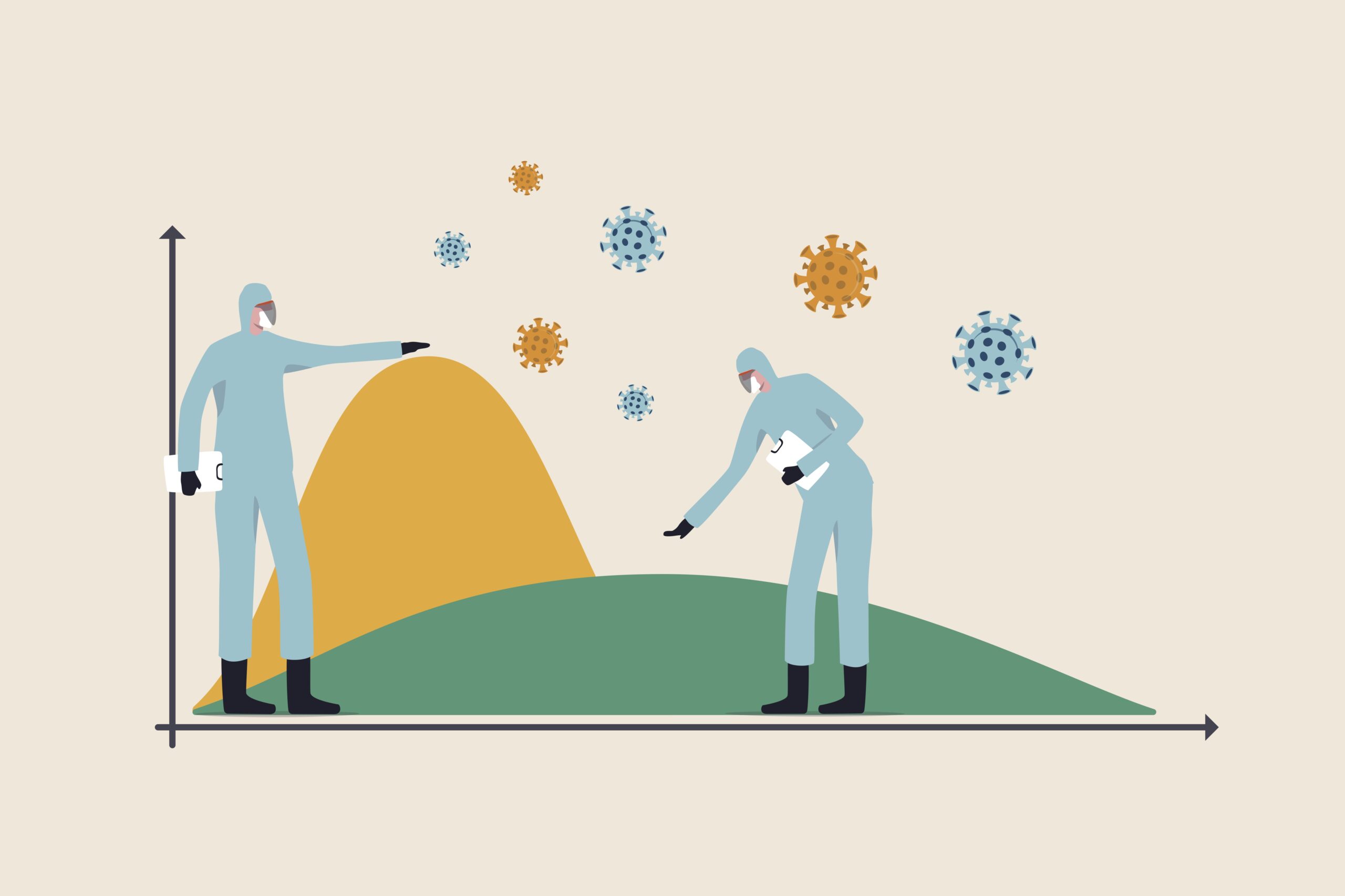
Illustration by Nuthawut Somsuk / Getty Images
(Two healthcare workers in full protective gear stand beside a line graph showing a tall infection curve and a flattened curve, with stylized virus icons floating around them.)